Getting your Open Water certification is the beginning of diving, not the end of it. Whether you’re ready to go deeper and take on more challenging sites, want the skills and confidence to help a buddy in an emergency, or just haven’t been in the water in a while and need to knock the rust off, there’s a next step built for you. This guide covers the three most important PADI continuing education Dubai: Advanced Open Water, Rescue Diver, and ReActivate.
PADI Continuing Education Dubai at a Glance
| Course | Who It’s For | Prerequisite | Length |
| Advanced Open Water Diver | Certified Open Water divers ready to go deeper and try new dive types | PADI Open Water Diver (or equivalent), minimum age 12 (Junior) or 15 | 3 days, 5 adventure dives |
| Rescue Diver | Divers who want to handle emergencies calmly and become a better dive buddy | PADI Advanced Open Water Diver + CPR/First Aid (e.g. EFR) within the last 24 months, minimum age 12 (Junior) | 3 to 4 days |
| ReActivate (Scuba Refresher) | Certified divers who haven’t dived in 6+ months and want to rebuild skills and confidence | Any prior scuba certification | A few hours to half a day, knowledge review, confined water, optional open water dive |
PADI Advanced Open Water Diver Course
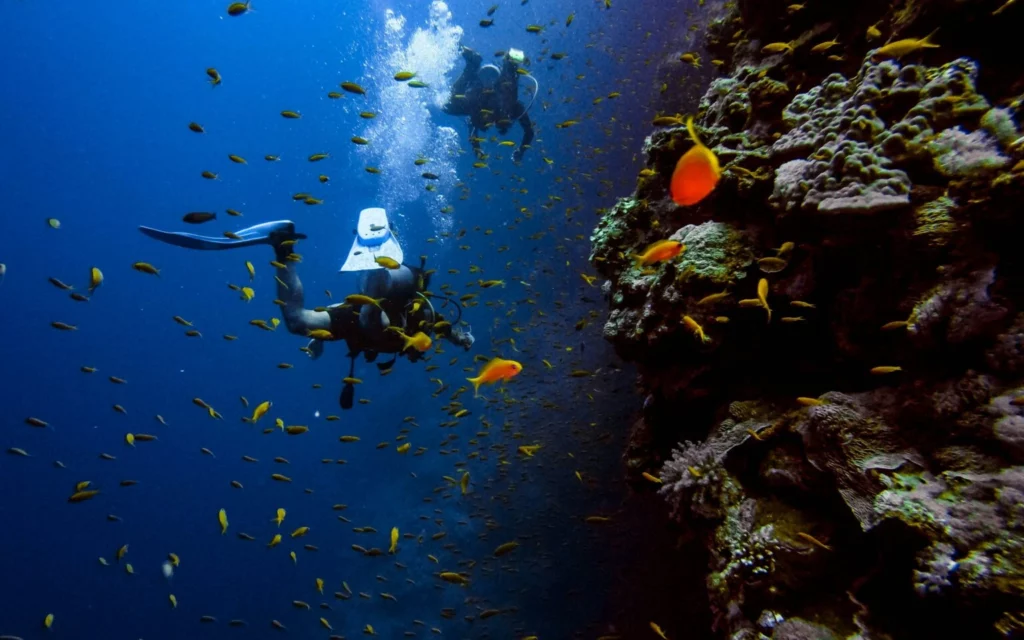
The PADI Advanced Open Water Diver course is the next level of scuba certification after Open Water, and it’s built around one thing: making you a safer, more capable diver. Where Open Water focuses on the basics, Advanced Open Water introduces five specialty dives, two mandatory (Deep and Navigation) and three elective, chosen from options like Peak Performance Buoyancy, Night Diving, Search and Recovery, Underwater Photography, and Wreck Diving.
What It Actually Teaches
The course builds real safety skills that stay with you across every dive you make afterward:
- Deep diving preparedness, managing nitrogen narcosis symptoms and safe ascent rates
- Underwater navigation mastery using compass and natural references
- Improved buoyancy control in varying conditions
- Night diving awareness and safety procedures
- Stronger emergency response habits across all dive types
It raises your depth qualification from 18 meters (Open Water) to 30 meters, and opens the door to more demanding diving, drift dives, wreck dives, and boat dives at remote sites, with the training to handle them safely.
There’s no final exam and no classroom test, just hands-on, in-water training. You can start immediately after completing your Open Water certification. Sessions run 2 to 3 hours, daily at 9 AM, 12 PM, and 3 PM. For the complete breakdown, see Are You Ready for Advanced Open Water?, which covers the e-Learning process, prerequisites, and what the five adventure dives actually involve.
Rami, who completed his Open Water at Nemo and returned for his Advanced, described the experience on Google:
“I did my Open Water here and came back for the Advanced, both have been amazing! The instructors are super friendly, professional, and make you feel safe while keeping everything fun. Great atmosphere, well-organized dives, and I always leave with a smile.”
— Rami K., Google Reviews
📍Enroll in the Advanced Open Water Diver Course
PADI Rescue Diver
The PADI Rescue Diver course is often called the most challenging, and most rewarding certification a recreational diver can earn. It’s built around self-rescue, recognizing stress in other divers, and managing emergencies both underwater and at the surface: the skills that turn a good dive buddy into someone the whole group actually relies on.
What the Course Covers
The course runs three main components:
- Knowledge development: recognizing diver stress, emergency management planning, and self-rescue techniques
- Confined water training: towing tired divers, surfacing an unresponsive diver, and performing in-water rescue breaths
- Open water rescue scenarios: rescuing unconscious divers at the surface, coordinating emergency responses, and managing panicked divers
The course typically takes 3 to 4 days.
Prerequisites
- PADI Advanced Open Water Diver certification (or equivalent)
- Valid CPR and First Aid training within the last 24 months, available through the PADI Emergency First Response course at Nemo Diving Center
Why It Matters Beyond the Certification
Rescue Diver is also a required step for anyone considering a professional diving path. Both the Divemaster and Instructor programs require Rescue Diver certification before entry. If a professional career in diving is on your radar, this is not an optional course. For the full course outline, see PADI Rescue Diver Course: A Guide to Overcoming Challenges and Building Confidence. If you’re not sure whether you’re ready for it, How to Know You’re Ready for the PADI Rescue Diver Course walks through the readiness signs in detail, and What Is the PADI Rescue Diver Course & Why Take It? covers the full curriculum and gear requirements.
PADI ReActivate: Scuba Refresher Dubai Getting Back in the Water After a Break
Not every diver needs to go deeper or learn rescue skills, sometimes what you need is to get back to where you were. If it’s been six months or more since your last dive, the PADI ReActivate program is built for exactly that.
What a Refresher Covers
A ReActivate session at Nemo Diving Center typically includes:
- Knowledge review: dive planning, air consumption, decompression limits, and emergency response
- Equipment review: BCD use, regulator handling, and alternate air source procedures
- Confined water session: mask clearing, buoyancy control, controlled ascents and descents, and entry/exit techniques
- Optional open water reef dive: available as an add-on to apply refreshed skills in real conditions
Upon completion, you receive a digital ReActivate certificate. Note that the optional open water dive fee is separate from the refresher course itself. Transportation to and from the training location is not included.
Why a Refresher Matters Before Your Next Trip
Many dive operators and liveaboards outside of Nemo will ask for proof of recent diving experience before taking you out. Completing a refresher in advance means you arrive ready rather than getting restricted or turned away once you’re at the site. For the full case on why it matters, see The Importance of a Scuba Refresher: Why You Should Brush Up on Your Skills, and for a practical breakdown of what to expect, see Top 5 Reasons to Take a Scuba Refresher Before Diving.
Choosing Your Next Step in PADI Training Dubai
The right course depends entirely on where you are in your diving journey:
- Certified Open Water diver ready to go deeper? Start with Advanced Open Water.
- Already have Advanced Open Water and want to be the diver your group counts on? Rescue Diver is the natural next step, and a required one if you’re considering a professional path.
- Coming back after time away from the water? ReActivate gets you back to full confidence before your next trip, regardless of your certification level.
For a complete overview of the full PADI pathway from beginner to professional, read: The Complete Guide to PADI Courses in Dubai for Beginners
Practical Information
Location: Azure Residences, Palm Jumeirah, Dubai
Dive base: Royal Beach, Dibba Al-Fujairah
Session times: 9 AM, 12 PM, 3 PM, daily, 7 days a week
Parking: Free on-site at Palm Jumeirah
Booking: Online at nemodivingcenter.com
Phone: +971 56 7044 472 (Dubai) | +971 58 5044 450 (Fujairah)
Email: info@nemodivingcenter.com | dive@nemodivingcenter.com
Final Thoughts
The Open Water certification is a starting point, not a finish line. Every course beyond it, whether it’s five adventure dives with Advanced Open Water, emergency scenario training with Rescue Diver, or a half-day refresher with ReActivate, makes you a more capable, more confident, and safer diver. Nemo Diving Center runs all three out of Dubai with PADI-certified instructors who adapt the training to your pace and experience level.
Browse continuing education courses and book online →
Frequently Asked Questions
Do I need to wait before enrolling in the Advanced Open Water course after my Open Water certification?
No. You can start the Advanced Open Water course immediately after completing your Open Water Diver certification. There is no mandatory waiting period. The only requirement is a valid PADI Open Water Diver certification (or equivalent from another recognized agency) and a minimum age of 15 (or 12 for the Junior Advanced Open Water Diver).
What CPR and First Aid course does Nemo Diving Center offer to meet the Rescue Diver prerequisite?
Nemo offers the PADI Emergency First Response (EFR) course, which fulfills the CPR and First Aid requirement for the Rescue Diver course. The EFR certification must be dated within the 24 months prior to starting your Rescue Diver course.
How long is the PADI ReActivate refresher at Nemo Diving Center?
The ReActivate program takes a few hours to half a day. It includes an online knowledge review, an equipment briefing, and a confined water session. An optional open water reef dive is available as a separate add-on for divers who want to apply their refreshed skills in real conditions.
Is the optional open water dive included in the ReActivate course fee?
No. The optional open water reef dive is an add-on and carries a separate fee. Transportation to and from the dive location is also not included. Contact Nemo Diving Center directly for current add-on details.
Can I do the Advanced Open Water and Rescue Diver courses back to back?
Yes. Many divers complete both courses during a single stay in Dubai. Advanced Open Water takes 3 days and Rescue Diver takes 3 to 4 days, the full sequence can be completed in approximately one week, provided your Emergency First Response certification is current or completed alongside the Advanced course.
Is Rescue Diver mandatory before becoming a Divemaster?
Yes. The PADI Rescue Diver certification is a required prerequisite for both the Divemaster program and the PADI Instructor Development Course. It is not optional for anyone pursuing a professional diving path.
Do continuing education courses at Nemo Diving Center have to be completed on consecutive days?
No. Sessions can be spread across non-consecutive days as long as the full course is completed within six months of the first session. Nemo’s daily scheduling at 9 AM, 12 PM, and 3 PM makes it straightforward to fit training around work or travel.
Nemo Diving Center is located at Azure Residences, Palm Jumeirah, Dubai, with a dive base at Royal Beach, Dibba Al-Fujairah. Open water course dives are conducted in Fujairah. Free on-site parking is available at the Palm Jumeirah facility. Bookings are made online at nemodivingcenter.com.